
1. Introduction
With the explosive growth of internet devices and enterprise network terminals, the global demand for public IPv4 addresses has long exceeded the theoretical supply capacity. IPv4, with a 32-bit address structure, can only provide approximately 4.3 billion unique public addresses, which is far from enough to support massive smart terminals, enterprise servers and mobile internet devices. Network Address Translation (NAT), as one of the core network gateway technologies, was proposed to solve the shortage of public IP addresses.
Deployed on routers, firewalls and network gateways, NAT realizes the mutual conversion between private network IP addresses and public network IP addresses. It allows multiple internal network devices to share a single or multiple public IPs to access the internet. Beyond address resource conservation, NAT also provides network isolation and internal security protection, and has become an indispensable basic technology in home networks, enterprise local area networks and operator network architectures. This paper systematically elaborates on the technical principles, classification, working processes and practical application cases of NAT, analyzing its core values in modern networks.
2. Basic Principles and Core Concepts of NAT
2.1 Definition and Core Mechanism
NAT is a network layer address translation technology defined by RFC 3022. Its core working mechanism is to rewrite the source and destination IP address information of data packets when they pass through the network gateway. For data packets transmitted from the private network to the public network, NAT replaces the internal private IP address with a public IP address; for return data packets from the public network, it restores the public IP address to the corresponding private IP address, so as to complete end-to-end data transmission.
The core of NAT implementation lies in the translation mapping table maintained by the gateway device. The table records the one-to-one correspondence between internal private IP+port and external public IP+port. All address conversion operations are completed in real time at the network layer without affecting the normal transmission of data packets and upper-layer application protocols, ensuring network transparency for terminal users.
2.2 Key Network Address Types
2.2.1 Private Network IP Address
Private IP addresses are dedicated address segments for internal local area networks, which cannot be routed and identified on the public internet. The Internet Assigned Numbers Authority (IANA) has reserved three fixed private address segments: 10.0.0.0–10.255.255.255, 172.16.0.0–172.31.255.255, and 192.168.0.0–192.168.255.255. These addresses can be reused by different local networks worldwide, greatly reducing the occupation of public IP resources.
2.2.2 Public Network IP Address
Public IP addresses are unique global network addresses assigned by operators. They can be directly accessed and routed on the internet. A public IP corresponds to an independent network identity on the public network, which is the basic prerequisite for internal network devices to communicate with external internet servers and terminals.
3. Classification and Working Process of NAT
3.1 Main Types of NAT Technology
3.1.1 Static NAT
Static NAT is a fixed one-to-one address mapping mode, which manually binds a single private IP address to a fixed public IP address. The mapping relationship remains unchanged for a long time and is mainly applicable to enterprise internal servers that need permanent public network access, such as web servers and mail servers. This mode supports bidirectional access, allowing external public network users to access internal designated servers stably.
3.1.2 Dynamic NAT
Dynamic NAT realizes dynamic matching between private IPs and public IP address pools. When an internal device accesses the public network, the gateway randomly allocates an idle public IP for address conversion. After the network connection ends, the public IP will be released and recycled for other internal devices. This mode improves the utilization rate of public IP addresses but cannot support external active access to internal devices.
3.1.3 NAPT (Network Address Port Translation)
NAPT is the most widely used NAT mode in daily networks, also known as port multiplexing NAT. It allows multiple internal private IP devices to share a single public IP, and distinguishes different terminal devices through different port numbers. This technology maximizes the utilization of public IP resources and is the core technology of home broadband and enterprise office networks.
3.2 Standard NAT Working Flow
The complete data packet translation process of NAPT, the mainstream NAT mode, is shown in the following flowchart:
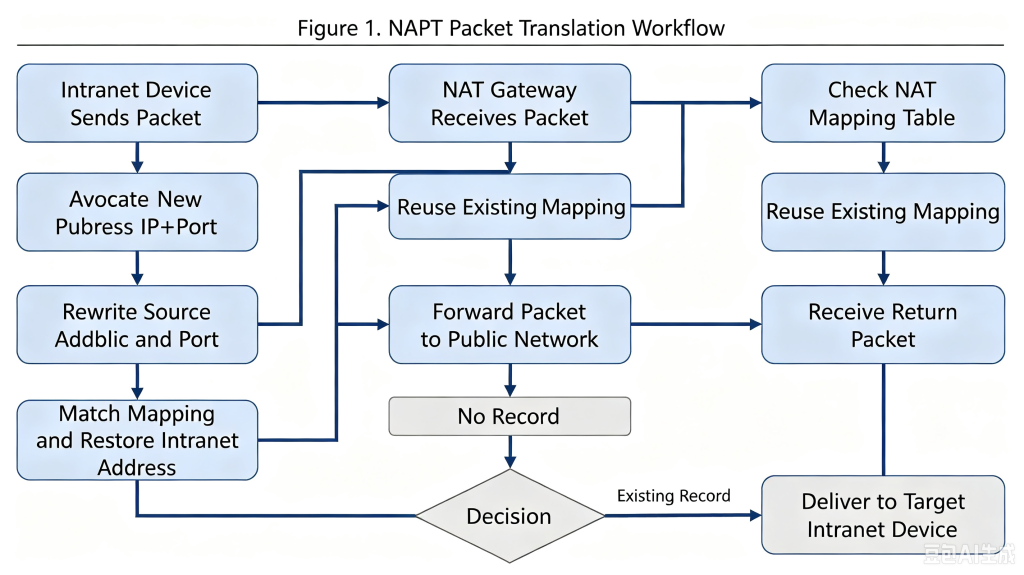
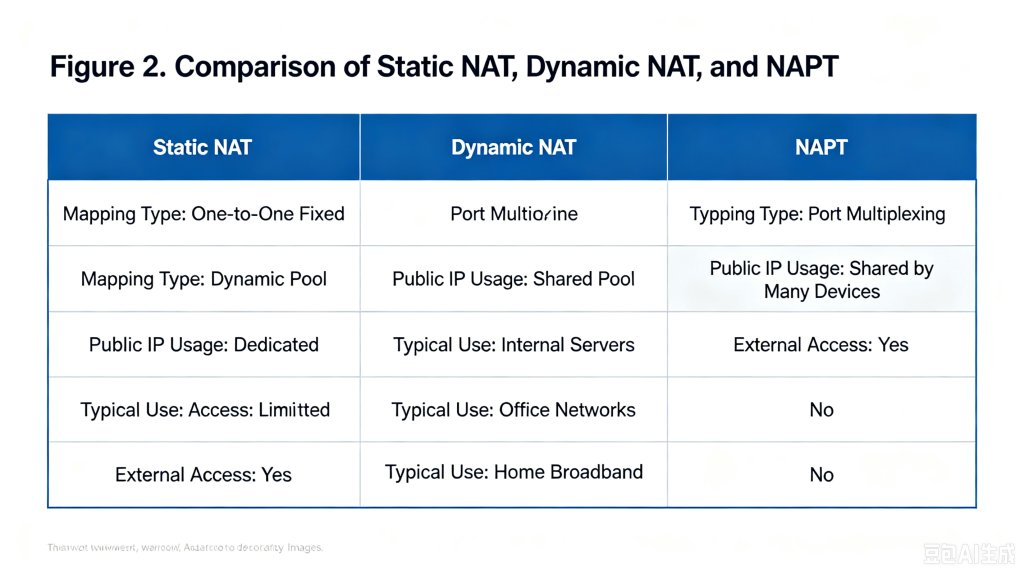
In the whole process, the NAT gateway only modifies the address and port information of the data packet header, and the data payload remains completely unchanged, ensuring the integrity and accuracy of network transmission.
4. Practical Application Cases of NAT Technology
4.1 Home Broadband Network Application (NAPT Mode)
In family network scenarios, operators only assign one public IP address for each household broadband. Multiple devices such as mobile phones, computers, and smart TVs in the home need to access the internet simultaneously. The home router enables the NAPT function by default, assigning independent private IP addresses (192.168.1.x segment) to all internal smart devices.
When multiple home devices access the internet at the same time, the router uses different port numbers for mapping conversion. For example, the computer uses port 1024 and the mobile phone uses port 1025 under the same public IP. The gateway accurately distinguishes different device data streams through port numbers, realizing multi-device shared network access. This case fully reflects the core value of NAT in saving public IP resources.
4.2 Enterprise Server Deployment (Static NAT Mode)
A small and medium-sized enterprise deploys an internal official website server (private IP: 192.168.1.100) and needs to provide external public network access services. The enterprise configures static NAT mapping on the core firewall, binding the internal server private IP to the fixed public IP assigned by the operator.
After configuration, external users can access the enterprise official website through the public IP address. At the same time, other internal office devices adopt NAPT mode to share the public IP for internet access. This case realizes the differentiated application of NAT technology, which not only meets the external service release of enterprise servers, but also ensures the safe internet access of internal office terminals.
4.3 Enterprise Dynamic NAT Pool Application
A medium-sized enterprise with 200 office terminals has obtained 5 available public IP addresses from the operator. To balance network access efficiency and IP resource utilization, the network team deploys a dynamic NAT address pool on the core router. All internal office terminals use private IP segments of 10.0.0.0/24 and dynamically obtain public IPs from the NAT pool when accessing the internet.
When employees browse websites, send emails or access cloud systems, the gateway automatically assigns idle public IPs for address translation. Once the network session is terminated, the occupied public IP is immediately released back to the pool for reuse. Compared with single-port multiplexing NAPT, dynamic NAT pool effectively disperses network traffic, reduces port conflict risks, and improves the stability of enterprise multi-terminal concurrent access, which is very suitable for medium and large enterprise office scenarios.
4.4 Cloud VPC NAT Gateway Application
Cloud Virtual Private Cloud (VPC) scenarios are important modern applications of NAT technology. Internet enterprises deploy multiple cloud servers in VPC, which are configured with private IPs for internal service communication. To ensure secure external network access, the enterprise configures a dedicated NAT gateway for the VPC.
All cloud host egress traffic is uniformly converted through the NAT gateway’s public IP. This design hides the internal VPC network topology and private IP addresses, preventing cloud servers from being directly exposed to the public network and resisting malicious scanning and network attacks. Meanwhile, it allows dozens of cloud devices to share one public IP for data upload, download and external API interaction, greatly reducing cloud network deployment and IP resource costs.
5. Core Functions and Advantages of NAT
First, NAT effectively solves the problem of IPv4 address exhaustion. Through address multiplexing, dozens or even hundreds of internal devices can share one public IP, which greatly improves the utilization rate of public network address resources and delays the shortage crisis of IPv4 addresses.
Second, NAT enhances internal network security. The private IP address of internal devices is hidden behind the gateway and cannot be directly accessed by external public network devices, which effectively avoids external network attacks and illegal scanning against internal terminals, and builds a basic network isolation barrier for enterprise and home networks.
In addition, NAT simplifies network operation and maintenance. Enterprises do not need to apply for a large number of public IPs for internal devices, reducing network deployment costs and IP resource management pressure. At the same time, the internal network address adjustment will not affect the external public network architecture, improving network flexibility.
6. Conclusion
As a classic and core technology of modern computer networks, NAT solves the bottleneck problem of IPv4 address resource scarcity through flexible address conversion mechanisms. Its three mainstream modes, static NAT, dynamic NAT and NAPT, perfectly adapt to diversified scenarios including enterprise server publishing, large-scale office network access, home broadband networking and cloud VPC secure access. With diversified practical applications, NAT not only maximizes public IP resource utilization, but also builds a solid isolation barrier for internal network security.
Although with the gradual popularization of IPv6 technology, the address scarcity problem will be fundamentally solved, NAT will still play an irreplaceable role in network security isolation, network architecture optimization and intranet-extranet communication adaptation. It will continue to be a basic core technology supporting the stable operation of various local area networks and enterprise networks in the future.