
1. Introduction
In the era of big data and cloud-native architecture, real-time data ingestion and flow orchestration serve as the foundation of enterprise data platforms. Stable, efficient, and flexible data pipeline tools directly determine the quality, timeliness, and integrity of downstream data analysis, risk control, and business decision-making. Apache Flume and Apache NiFi are two mainstream open-source data flow tools with distinct positioning. Flume focuses on high-throughput log aggregation and lightweight streaming transmission, while Apache NiFi delivers visual, configurable, and full-functional data orchestration for complex heterogeneous scenarios. This article conducts an in-depth comparative analysis of their architecture, core capabilities, and applicable scenarios, supplements multiple industrial practical cases, and constructs a high-compatibility Flume-NiFi hybrid architecture, providing systematic tool selection and architecture design guidelines for enterprises.
2. Fundamental Architecture and Operating Mechanism
2.1 Apache Flume Core Architecture
Apache Flume is a lightweight distributed data ingestion tool designed for massive log and event data transmission. It adopts a streamlined Agent-based architecture, with each independent Agent process composed of three core components: Source, Channel, and Sink. The linear data transmission mode ensures ultra-high throughput and low resource overhead, making it suitable for large-scale homogeneous data collection scenarios.
2.1.1 Flume Full-Size Data Flow Workflow
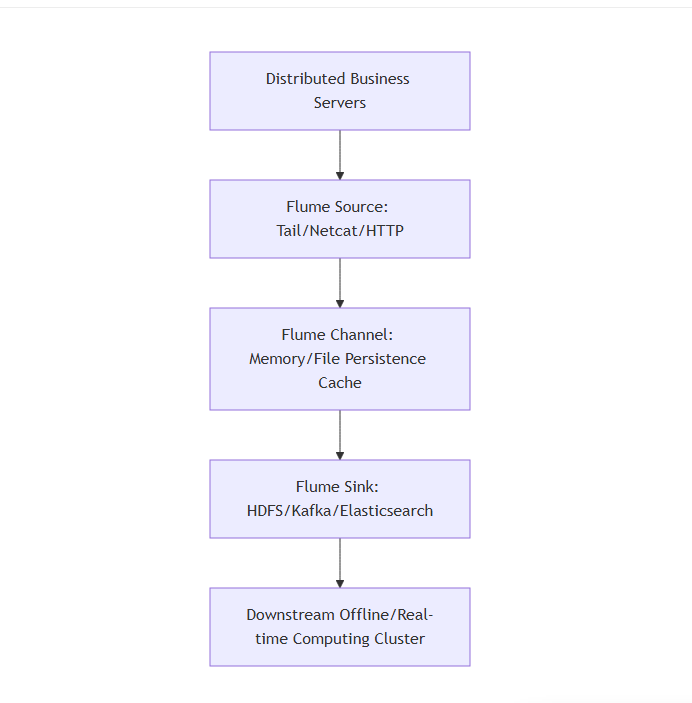
Flume Source collects raw log data from servers, sensors, and applications and encapsulates discrete data into standard Flume Events. Channel provides reliable data caching, where file channels prevent data loss during node failures, and memory channels guarantee low-latency transmission. Sink adopts batch pulling mode to upload data to centralized storage and computing platforms, supporting multi-agent cascading aggregation and multi-terminal shunt transmission.
2.2 Apache NiFi Core Architecture
Apache NiFi is a visual, programmable, and enterprise-level data flow orchestration tool oriented to complex heterogeneous data scenarios. Different from Flume’s fixed linear structure, NiFi adopts a flow-driven architecture with FlowFile as the basic data carrier. It supports full-link data processing including ingestion, cleaning, conversion, routing, and delivery, and provides a web-based visual console for dynamic pipeline adjustment without code modification.
2.2.1 NiFi Full-Size Heterogeneous Data Orchestration Flow
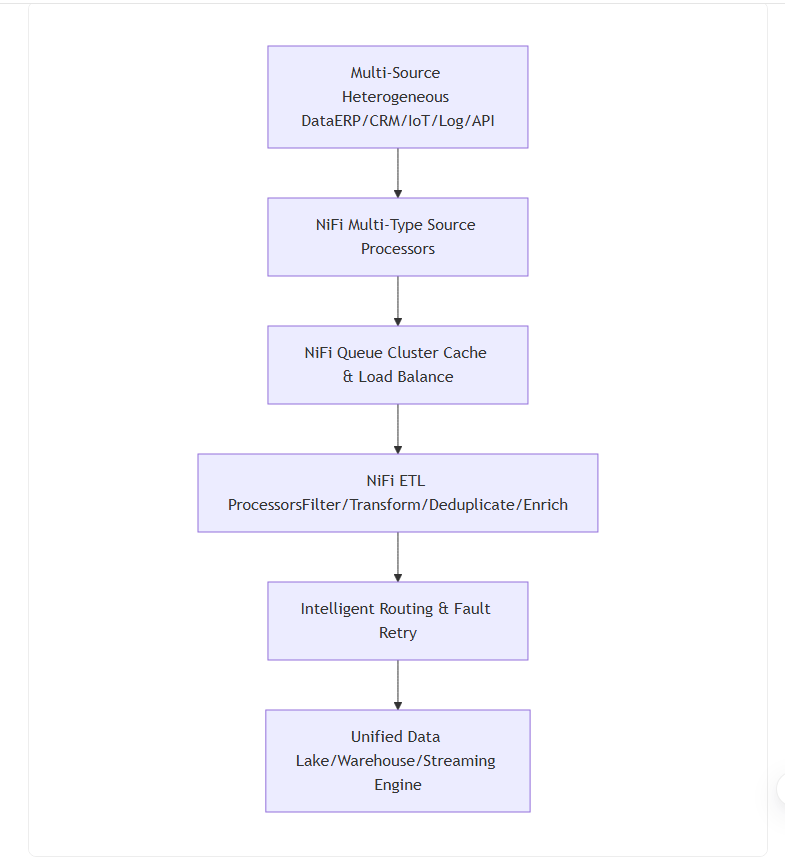
NiFi integrates hundreds of built-in processors to adapt to diverse data sources and destinations. It supports real-time flow monitoring, data backtracking, breakpoint resume transmission, and fine-grained data quality control. Its cluster deployment mode realizes automatic failover and horizontal scaling, which solves the problem of difficult orchestration of multi-format and multi-protocol complex data in enterprise scenarios.
3. Multi-Dimensional Capability Comparison
3.1 Flexibility and Operation Maintainability
Flume relies entirely on static configuration files for pipeline deployment. It features simple configuration and low resource consumption but lacks visual monitoring capabilities. Any pipeline modification requires service restart, resulting in poor flexibility and adaptability for dynamic business changes. In contrast, NiFi supports real-time drag-and-drop pipeline construction, dynamic rule adjustment, and visual operation monitoring. Operation and maintenance personnel can quickly locate backlog, failure, and abnormal data problems, greatly reducing pipeline maintenance costs.
3.2 Data Processing and Orchestration Capabilities
Flume is a pure data transmission tool with limited processing capabilities, only supporting simple log filtering and format trimming. All complex ETL operations must rely on downstream computing frameworks. NiFi supports full-process ETL processing, including data deduplication, field parsing, format conversion, conditional routing, and data encryption, which can independently complete end-to-end data standardization and meet refined data governance requirements.
3.3 Throughput, Reliability and Scalability
Flume has outstanding throughput performance in homogeneous log scenarios, supporting million-level data transmission per second with stable performance and zero data loss based on persistent channels. Its scalability is limited to simple cluster cascading. NiFi has slightly higher resource overhead but provides stronger scalability and fault tolerance, supporting priority scheduling, abnormal retry, and multi-node load balancing, which is more suitable for complex enterprise-level data flow scenarios.
4. Rich Practical Industrial Application Cases
4.1 Typical Flume Application Cases
4.1.1 E-Commerce User Behavior Log Aggregation
Large e-commerce platforms such as Flipkart and Amazon deploy Flume Agent clusters on front-end servers and application servers to collect user browsing, clicking, adding-to-cart, and order operation logs. Through multi-level cascading Flume clusters, scattered log data is aggregated uniformly, and synchronously sinked to Kafka for real-time user portrait analysis and HDFS for offline behavioral statistics. This solution stably supports tens of millions of daily log data transmission, ensuring high throughput and low delay while reducing server resource occupation.
4.1.2 Industrial IoT Equipment Data Collection
Intelligent manufacturing enterprises deploy Flume on edge industrial gateways to collect real-time operating data of production equipment, including temperature, pressure, vibration, and operating status data. Flume’s lightweight deployment feature adapts to edge devices with limited performance. It transmits massive IoT sensing data to Spark Streaming for real-time equipment fault early warning and production efficiency monitoring, realizing unmanned intelligent monitoring of production lines.
4.2 Typical NiFi Application Cases
4.2.1 Retail Cross-System Data Synchronization
A national retail chain uses Apache NiFi to build a unified data synchronization pipeline, realizing real-time data docking between offline warehouse ERP inventory data, online e-commerce platform order data, and member CRM system data. NiFi automatically cleans inconsistent data formats, eliminates duplicate data, and realizes intelligent data shunt, ensuring real-time inventory synchronization and accurate order statistics, solving the data isolation problem between online and offline business systems.
4.2.2 Semiconductor Factory Manufacturing Data Governance
Global semiconductor manufacturer Micron applies NiFi to collect multi-source heterogeneous data from production workshops, including equipment processing parameters, product testing data, and production environment monitoring data. NiFi completes data standardization, quality inspection, and classified storage, and synchronizes qualified data to the factory’s industrial data lake, supporting production process optimization and product quality traceability, greatly improving the automation level of factory data governance.
4.2.3 Financial Risk Control Data Ingestion
Regional commercial banks use NiFi to access multi-channel financial data such as core transaction data, customer mobile banking operation data, and third-party credit data. NiFi realizes encrypted transmission, data verification, and abnormal data screening of financial sensitive data, provides high-quality standardized data for real-time risk control engines, and effectively prevents fraudulent transactions and financial risks.
5. Flume + NiFi Hybrid Architecture Design
5.1 Hybrid Overall Architecture Flow
5.2 Architecture Division of Labor and Core Advantages
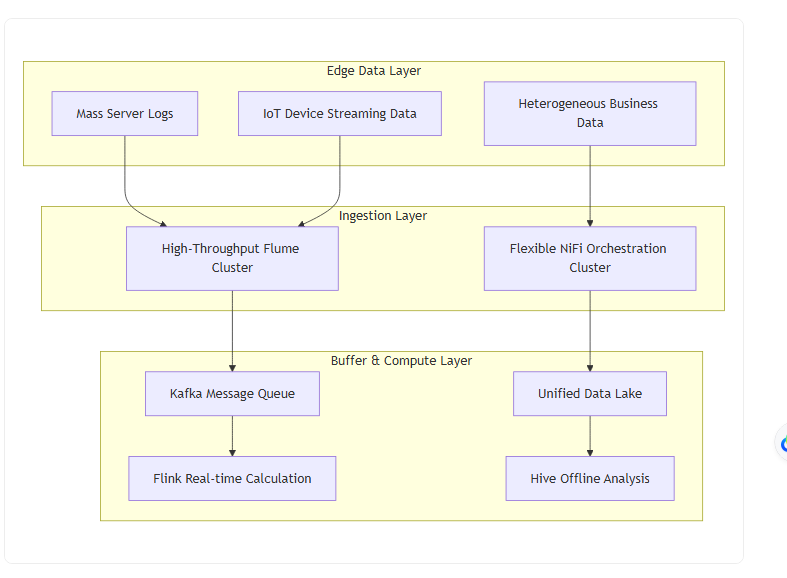
The hybrid architecture gives full play to the respective strengths of the two tools. Flume undertakes the underlying high-throughput collection and aggregation of homogeneous logs and IoT streaming data, ensuring transmission efficiency and stability. NiFi is responsible for accessing, cleaning, and sophisticated orchestration of complex heterogeneous business data to improve data quality. With Kafka as the middle decoupling layer, the architecture realizes layered processing of different types of data.
This design effectively avoids NiFi’s resource waste in high-throughput simple scenarios and makes up for Flume’s lack of ETL orchestration capabilities. It realizes full-scenario coverage of enterprise data pipelines, significantly improving the robustness, flexibility, and scalability of the entire data platform.
6. Tool Selection Criteria and Conclusion
6.1 Tool Selection Principles
Enterprises should select tools based on business scenarios. For single-type log aggregation, edge streaming data transmission, and fixed low-complexity pipelines, Flume is preferred for its high efficiency and low overhead. For multi-source heterogeneous data access, dynamic pipeline adjustment, data governance, and complex ETL scenarios, NiFi is the best choice. For large and medium-sized enterprise full-scenario data platforms, the Flume and NiFi hybrid architecture is the optimal solution.
6.2 Conclusion
Flume and Apache NiFi have complementary advantages in data flow orchestration. Flume focuses on efficient and stable data transmission, while NiFi focuses on flexible and refined data processing and governance. Verified by multiple industrial practical cases, the hybrid architecture can perfectly adapt to complex enterprise data demands, provide reliable data pipeline support for big data analysis and intelligent business decision-making, and has high practical application and promotion value.