
1. Introduction to Linux Network Layer Architecture
The network layer (Layer 3) serves as the core hub of the Linux TCP/IP protocol stack, undertaking the critical tasks of packet addressing, segmentation, route calculation, and cross-network data forwarding. Unlike the data link layer that focuses on local link transmission and the transport layer responsible for end-to-end connection management, the Linux network layer centers on IP packet processing and intelligent route forwarding, enabling data packets to traverse complex network topologies and reach target hosts accurately. As a stateless protocol core, it relies on strict packet header rules and efficient routing algorithms to support high-concurrency network transmission, which is the fundamental guarantee for Linux servers, routers, and container network communication.
The entire network layer workflow follows a fixed logic: receive data frames from the link layer → parse IP packet headers → verify packet validity → query routing entries → execute forwarding or local delivery → push packets to the upper layer or forward to the next hop. This article systematically analyzes IP packet structural rules, Linux kernel forwarding mechanisms, routing table matching logic, and verifies underlying principles through practical operation cases and process flowcharts.
2. Core Structure and Parsing Logic of IP Packets
2.1 Standard IPv4 Packet Header Composition
All network layer forwarding behaviors in Linux are based on standard IP packet headers. The IPv4 header ranges from 20 to 60 bytes, carrying all addressing and control information required for forwarding. Key fields include version, header length, TTL (Time To Live), protocol number, source IP, destination IP, and checksum. Each field strictly restricts the kernel’s processing logic for packets.
The TTL field is a core anti-loop mechanism unique to Linux network forwarding. The kernel automatically subtracts 1 from the TTL value of each forwarded packet; when TTL decreases to 0, the packet is discarded, and an ICMP timeout message is returned to the source host, effectively preventing infinite packet loops in complex routing topologies. The protocol number field identifies the upper-layer protocol (6 for TCP, 17 for UDP, 1 for ICMP), guiding the kernel to deliver processed packets to the corresponding transport layer protocol.
2.2 Linux Kernel IP Packet Processing Flowchart & IP Header Structure Diagram
To intuitively display the underlying composition of IP packets and the end-to-end processing logic of the Linux kernel, the standard IPv4 header structure and complete kernel packet processing flow are shown in the following figures, which correspond to the core parsing rules mentioned above.
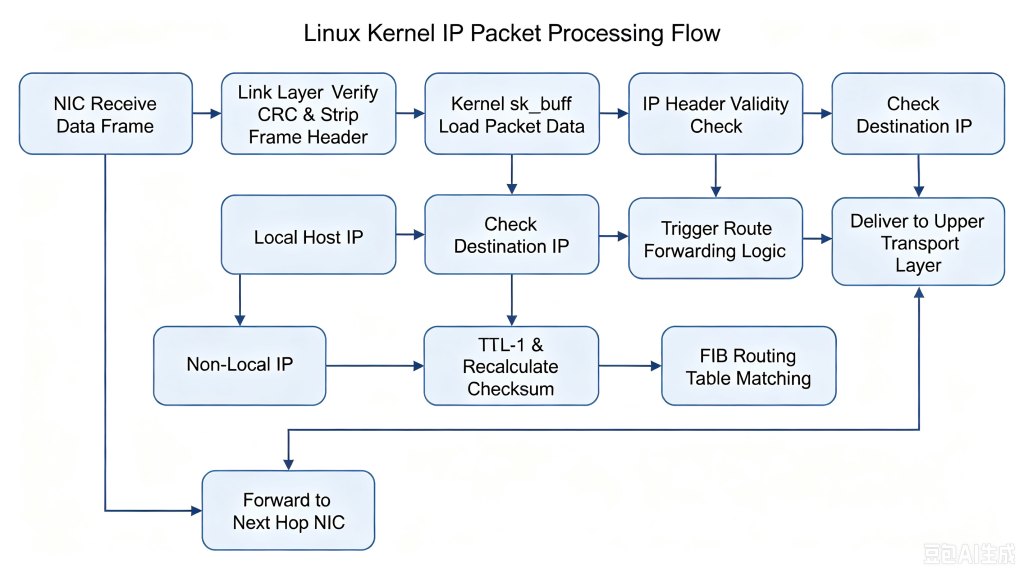
The above flowchart shows the full lifecycle of IP packets in the Linux kernel. The sk_buff (socket buffer) is the core data structure for kernel packet processing, uniformly storing packet data, header information, and forwarding status, realizing zero-copy transmission and efficient data processing throughout the network stack .
2.3 Practical Case 1: IP Packet Abnormal Discarding Analysis
In actual operation, many network failures stem from abnormal IP packet header parsing. A typical case: a enterprise Linux server cannot access cross-segment devices, with normal local network communication. Through tcpdump packet capture, it is found that all cross-segment IP packets are discarded by the kernel.
Troubleshooting process: First, check the TTL value of outgoing packets. The default Linux TTL is 64. The cross-segment path passes through 6 routing hops, resulting in TTL reduction to 0 and packet timeout discard. The root cause is abnormal TTL modification by intermediate network devices. After resetting the global TTL parameter of the Linux server (sysctl -w net.ipv4.ip_default_ttl=128), cross-segment communication returns to normal. This case verifies that the IP header TTL field directly determines packet forwarding survivability.
3. Linux Routing Forwarding Underlying Mechanism
3.1 Core Routing Components: RIB and FIB
Linux kernel routing forwarding relies on two core data structures: RIB (Routing Information Base) and FIB (Forwarding Information Base). RIB is the original routing information database, storing static routes, dynamic routes (OSPF/BGP), and direct connection routes, responsible for collecting and updating all routing entries . FIB is an optimized forwarding table compiled from RIB, adopting a trie data structure to realize efficient longest prefix matching, which is the real basis for kernel fast packet forwarding .
The kernel distinguishes control plane and data plane: the control plane completes RIB entry update through routing protocols, while the data plane queries FIB entries in real time for each packet, ensuring forwarding efficiency up to millions of packets per second. When routing entries change, the kernel automatically synchronizes RIB data to FIB without interrupting normal packet forwarding.
3.2 Longest Prefix Matching Rule
Linux routing forwarding follows the longest prefix match principle, which is the core rule for FIB table query. When a packet’s destination IP matches multiple routing entries, the kernel selects the entry with the longest subnet prefix for forwarding . For example, if the routing table contains 0.0.0.0/0 (default route) and 192.168.2.0/24 (specific route), packets destined for 192.168.2.10 will prefer the /24 specific route instead of the default route.
3.3 Practical Case 2: Routing Matching Failure Fault Resolution
Fault scenario: A Linux gateway server is configured with both a default route and a static route for the 10.0.0.0/8 network segment. When accessing 10.1.0.0 segment devices, packets are forwarded through the default route instead of the specified static route, resulting in access failure.
Troubleshooting steps: First, use ip route show to check routing entries and find that the static route was configured as 10.0.0.0/16 by mistake, with a shorter prefix than the expected /8 segment. According to the longest prefix matching rule, the kernel fails to match the 10.1.0.0 segment and falls back to the default route. After correcting the route entry to 10.0.0.0/8, the forwarding path returns to normal. This case fully reflects the deterministic priority logic of Linux routing matching.
3.4 Practical Case 3: Kernel Forwarding Switch Abnormality
Default Linux servers disable the kernel forwarding function, limiting packet cross-network transmission. A common enterprise network scenario: two subnets (192.168.1.0/24 and 192.168.2.0/24) use a Linux server as a gateway, but the two subnets cannot communicate with each other.
Root cause: The kernel forwarding switch net.ipv4.ip_forward is 0 (disabled). After executing sysctl -w net.ipv4.ip_forward=1 and saving the configuration permanently, the kernel enables the Layer 3 forwarding capability, and cross-subnet packet transmission is realized. This case verifies that the kernel forwarding switch is the prerequisite for all Layer 3 routing behaviors.
4. Typical Forwarding Scenarios and Performance Optimization
4.1 NAT Forwarding Scenario Principle
In enterprise networks and container environments, Linux often undertakes NAT (Network Address Translation) forwarding tasks. Based on the Netfilter framework, the kernel modifies the source/destination IP and port information of IP packets, realizing access from private network addresses to public networks . The core logic is: after matching the FIB route, the kernel triggers NAT rules to rewrite packet headers, and forwards the modified packets to the next hop.
4.2 Practical Case 4: Container Network Forwarding Exception
Fault scenario: Docker containers on a Linux host can access the external network, but external devices cannot access container services. Troubleshooting found that the kernel’s FIB routing entries are normal, but the iptables NAT forwarding rules are missing.
Solution: Configure SNAT rules for container network segments to ensure that container outgoing packets are converted to the host public IP, and add DNAT port mapping rules for external access. After the configuration is completed, bidirectional forwarding between external networks and containers is normal. This case confirms that Linux network layer forwarding needs to cooperate with Netfilter rules to complete complex network scenarios.
4.3 Forwarding Performance Optimization Suggestions
For high-concurrency forwarding scenarios, Linux can optimize network layer performance through multiple mechanisms: enable FIB route caching to reduce repeated query overhead; adjust the skb buffer size to avoid packet loss; enable NAPI polling mode to reduce NIC interrupt overhead ; and use BPF tools to optimize route matching efficiency. These optimizations focus on reducing kernel overhead in packet parsing and routing query links, significantly improving forwarding throughput.
4.4 Practical Case 5: MTU Mismatch Causing Fragmentation Packet Loss
Packet fragmentation is a key underlying mechanism of the Linux network layer. The IPv4 protocol allows splitting oversized packets according to MTU (Maximum Transmission Unit), and unreasonable MTU configuration is a common cause of silent network packet loss in production environments. A typical enterprise scenario: a Linux application server runs normally for small-packet services such as ping and SSH, but frequently loses packets and times out when transmitting large files or accessing web services.
Troubleshooting and analysis: Use ip link show to check the NIC MTU value. The server eth0 interface is manually configured with an MTU of 100 bytes, far lower than the standard Ethernet MTU of 1500 bytes. When the server sends large IP packets, the kernel forcibly fragments the packets. Excessive fragmentation increases kernel processing overhead, and any fragmented packet loss will cause the entire data transmission to fail. In addition, many intermediate network devices disable fragmented packet forwarding by default, further aggravating packet loss problems.
Solution: Restore the standard MTU configuration via ip link set eth0 mtu 1500 and match the MTU parameters of upper and lower network devices. After modification, large-packet transmission is stable without loss. This case reveals that the network layer’s fragmentation mechanism and MTU matching rules directly affect the reliability of actual data transmission.
4.5 Practical Case 6: Multi-NIC Route Routing Interface Mismatch Fault
Production Linux gateways and servers are usually equipped with multiple network cards, and unreasonable routing interface binding often causes forwarding anomalies, which is a typical network layer routing logic failure. Fault scenario: A Linux gateway has two NICs (public network eth0 and private network eth1). The private network segment can access the public network normally, but external public network access to intranet services fails randomly.
Root cause positioning: Capture and analyze packets through tcpdump. It is found that the gateway receives external access packets from the eth0 public network interface, but returns response packets through the eth1 private network interface. The core reason is that the FIB routing table query result does not match the inbound interface. The default routing rule causes the response packet to select the wrong outgoing interface, resulting in asymmetric routing and session connection failure.
Fix method: Configure policy-based routing on the Linux kernel, bind the inbound interface and the corresponding routing entry, and restrict response packets to return through the original inbound interface. After the policy routing takes effect, the multi-NIC bidirectional forwarding is completely normal. This case fully verifies that the Linux network layer’s route matching not only depends on the destination IP prefix, but also needs to cooperate with interface constraints in complex multi-network scenarios to ensure accurate forwarding.
5. Conclusion
The Linux network layer’s core capability lies in standardized IP packet parsing and efficient routing forwarding. From the underlying IP packet header verification, sk_buff data carrying, to FIB-based longest prefix matching and multi-scenario forwarding processing, every link follows rigorous kernel logic. Combined with multiple practical operation cases, it can be seen that most network forwarding faults are caused by parameter configuration errors, route entry mismatches, and function switch abnormalities.
In-depth understanding of the network layer underlying logic helps technicians quickly locate cross-segment communication failures, optimize server and gateway forwarding performance, and provide theoretical support for enterprise network architecture design, container network operation and maintenance, and high-performance network deployment. The stateless and high-efficiency characteristics of the Linux network layer also make it the mainstream core of modern server and embedded network devices.