
What Exactly Is the Transformer?
Proposed by Google in the 2017 landmark paper Attention Is All You Need, the Transformer is a revolutionary deep learning architecture that has redefined artificial intelligence technology. Abandoning the sequential computation defects of traditional RNN and LSTM models, it relies entirely on the self-attention mechanism to process sequence data efficiently. Today, the Transformer is no longer limited to natural language processing (NLP) but has become the universal core architecture for AI tasks. This article elaborates on its core structure, working principles, anddiversified real-world application scenarios with intuitive flowcharts and practical cases.
1. Basic Definition and Core Advantages of Transformer
The Transformer is a sequence-to-sequence (Seq2Seq) deep learning model designed for processing sequential data such as text, speech and time series. Its biggest innovation is taking self-attention as the core computing unit, realizing parallel computation of sequence data. Traditional RNN and LSTM models process text word by word in chronological order, which leads to low computation efficiency and difficulty in capturing long-distance semantic dependencies. In contrast, the Transformer can scan the entire sequence at one time, efficiently capture long-range correlations, and greatly improve model training speed and expression ability.
1.1 Core Strengths Compared with Traditional Models
The Transformer has two core competitive advantages over traditional recurrent neural networks. First, it supports full parallel computation. RNN and LSTM can only process text word by word chronologically, resulting in low training efficiency, while the Transformer computes all sequence elements simultaneously, perfectly adapting to GPU accelerated training and greatly shortening model iteration cycles. Second, it solves the long-distance dependency and gradient vanishing problems of traditional models. Its self-attention mechanism can directly build semantic associations between any two distant elements in a sequence, enabling accurate understanding of long text, long speech and other complex data. These two advantages lay the foundation for its wide application in various AI scenarios.
2. Overall Structural Composition of Transformer
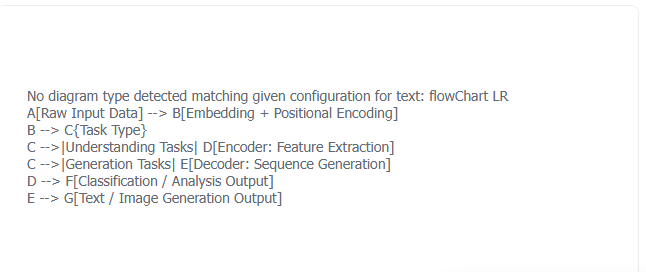
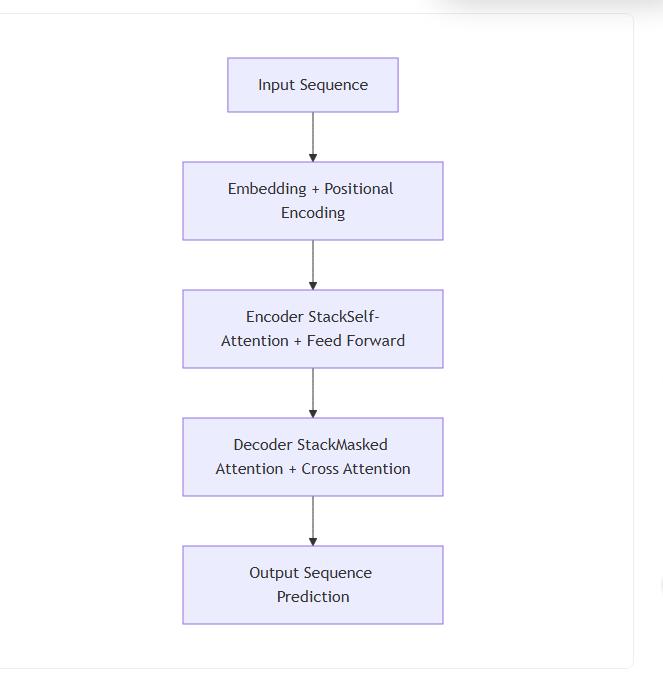
The standard Transformer adopts a dual-module structure of encoder and decoder, with distinct functional positioning for different AI tasks. The encoder focuses on feature extraction and semantic understanding, suitable for discriminative tasks, while the decoder undertakes content generation, applicable to generative tasks. Mainstream AI models selectively use these two modules according to application scenarios. The complete operating logic of the Transformer is shown in the flowchart below.
2.1 Encoder Module
The encoder is composed of multiple identical network layers stacked. Each layer contains two core sub-modules: multi-head self-attention mechanism and feed-forward neural network. Before inputting data into the encoder, the original text words will be converted into vector embeddings, and positional encoding will be added to mark the sequence order information. After attention calculation and feature transformation, the encoder outputs deep semantic feature vectors of the input sequence, providing basis for subsequent sequence generation.
2.2 Decoder Module
The decoder adds a masked multi-head self-attention layer on the basis of the encoder structure. The mask mechanism prevents the model from observing subsequent text information when generating the current word, ensuring the authenticity of sequence generation. In addition, the decoder contains a cross-attention layer, which can extract and fuse feature information output by the encoder, realize the semantic mapping from input sequence to target sequence, and complete text translation, text generation and other tasks.
3. Core Mechanism: Self-Attention
The self-attention mechanism is the core soul of the Transformer and the key to its multi-scenario adaptability. Different from traditional models that only focus on adjacent data, self-attention can traverse the global sequence, calculate the correlation weight between each element and all other elements, and automatically focus on key information. This global feature capture ability enables the Transformer to adapt to diverse data types and task scenarios.
3.1 Working Principle of Self-Attention
The self-attention mechanism completes calculation through three core vectors: Query, Key and Value. The model first maps the input vector to obtain Q, K, V vectors, calculates the similarity weight between Q and K through dot product operation, normalizes the weight through the Softmax function, and finally multiplies it with the V vector to obtain the weighted feature representation. This mechanism enables each word to fuse global semantic information, realizing comprehensive understanding of context.
3.2 Multi-Head Attention Mechanism
The Transformer does not use single-head attention, but adopts multi-head attention. It splits Q, K, V into multiple groups, performs independent attention calculation respectively, and then splices the results. This design enables the model to capture diverse semantic features such as grammar structure, semantic logic and word collocation at the same time, greatly enriching the model’s feature expression ability.
4. Typical Application Scenarios and Practical Cases
4.1 Natural Language Processing (Core Scenario)
NLP is the earliest and most mature application field of Transformer. Encoder-based models such as BERT are widely used in text classification, sentiment analysis, and intelligent question answering, which are applied in customer service robot and text review systems of major enterprises. Decoder-only models represented by GPT are committed to text generation, including article writing, machine translation, and code generation. For practical case, GitHub Copilot, a mainstream programming assistant, adopts Transformer architecture to automatically generate and optimize code, greatly improving developers’ work efficiency.
4.2 Computer Vision Scenario
Transformer breaks the monopoly of CNN in computer vision. Vision Transformer (ViT) converts images into sequence patches and uses self-attention to capture global image features. It is widely used in intelligent monitoring, face recognition, and medical image analysis. A typical case is intelligent medical diagnosis equipment, which uses ViT to analyze lesion images, accurately identify tumor lesions, and assist doctors in rapid diagnosis.
4.3 Multimodal and Industrial Scenarios
Modern Transformer-based multimodal models such as CLIP and DALL-E realize cross-modal conversion of text, images and audio, supporting AI painting, video generation and intelligent content creation. In the industrial field, Transformer is applied to time-series data analysis, realizing intelligent prediction of equipment faults and industrial data monitoring, providing technical support for intelligent manufacturing.
In conclusion, the Transformer is a universal AI architecture centered on the self-attention mechanism. It overcomes the limitations of traditional deep learning models with parallel computation and global feature capture capabilities. With flexible encoder-decoder combination, it covers core application scenarios such as natural language processing, computer vision and industrial intelligent analysis. Diverse practical cases prove that the Transformer is not only a technical breakthrough in academia, but also a core driving force for the commercial landing of modern artificial intelligence, laying an indispensable foundation for the iterative development of various AI industries.